26 July 2008

T-Shirts for Trees

WE ADD UP is a global campaign using organic cotton t-shirts that literally “counts you in” in the fight against global warming. Every shirt is printed by hand with a unique number. YOUR number represents your place in the sequential global count of all the people who are taking steps to help stop climate change. As the count grows, we demonstrate to the world that “WE ADD UP.” On the back of each organic cotton t-shirt is a word or phrase that describes an action almost anyone can take to reduce their carbon footprint - the contribution their lifestyle makes to greenhouse gases - such as, Unplug, Lights Off, Carpool, Hybrid, Bike, Buy Local, and 18 others. You choose which action you are committed to doing and get counted in. No one can do everything. Everyone can do something. And, WE ADD UP.

If you purchase a t-shirt through 'How to Make a Difference' then 10% of the purchase price goes to SALVEASERRA. And WE ADD UP donate 100% of their profit to charities working to stop global warming. And, what's more, if you purchase the Plant Trees t-shirt for only US$28 WE ADD UP will plant 10 (yes, ten!) trees in your name in the Rainforest.


Zemanta Pixie

24 July 2008

Who are you?

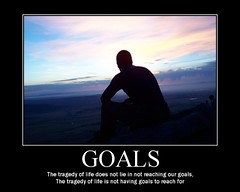
GoalsImage by
stilllearninghowtofly - W W Tribe Psychiatrist
via Flickr
How do you want to make a difference?

If you know you want to do something, but find it difficult to answer that question, it could be that you need to sit down and think about what is important to you.

Having a clearly defined set of values can energise you to achieve great things. They will help you to set goals that really resonate with you and say no to goals that aren't yours - you know the ones, the 'I really should . . .' sort of goals that are so hard to get motivated to achieve.

If you have a clear understanding of your core values you will be better able to avoid making reactionary decisions based on other peoples expectations, or your own mood at the time. Instead you can be true to yourself.

When you know who you are you can be clear about the standards of behaviour you expect from yourself and others. It helps you to set boundries and to say 'No' to people, situations and things that don't fit with your values.

There is also an incredible feeling of peace and fulfillment that comes with knowing yourself and being able to make decisions from a clearly defined 'centre'. You are propelled forward toward your goals and you attract people with similar values.

"Sounds great" You say . . . "But how do I find out my core values?"

First of all, schedule in some quiet time to really think about what matters to you. Then print out the Identifying your values workbook from SynergyInstitute.com and work through the steps.

Go for it!!!


Reblog this post [with Zemanta]

5 Ways to Simplify Your Life

A large Smithwick's ale billboard, just off Ti...Image via Wikipedia Life can get so complicated. We work 40 hours a week (or more!), we have families and friends to spend time with, wherever we go we are contactable by phone, IM, email, skype, twitter and even old fashioned paper mail (which is usually bills these days!!), then there's TV, Radio, Billboard advertising or some other media bombarding us with (mis)information wherever we go. Sometimes its hard to find time to remember to just breathe . . .

If its all getting a bit much for you, then it could be time to simplify your life. Time to cut the clutter and work on what really matters to you. So take a look at the list below an start paring your life back to the important stuff!

1. What is the important stuff for you?
What do you value most? What do you want to do in your life? Make a list of the 4 or 5 most important things to you. These are the things you want to simplify your life for, the things you want to have more time to do.

2. Practise saying 'NO'
If you don't learn to say the N-word, then you will never simplify your life. If it doesn't fit into your 'Important Stuff' list than say 'NO' . . . and mean it!

3. Slow down
Life isn't a race. Don't get caught up in the speed of modern day living. Take the time to enjoy the moment. Drive slowly - its safer and less stressful. Savour your food - you will tend to eat less and enjoy mealtimes more. Listen - don't hurry conversations along by planning your next move instead of listening with your full attention.

4. Decide what is enough
We are constantly being told we need to have more, to buy more. If you really want to live a more simple life you need to decide how much is enough. Its much easier to declutter your posessions and your schedule once you know what enough is for you.

5. Spend time doing what you love
If you prioritise your time to do the things that you love, you'll find that your days become less hectic and more pleasurable. Sure, you still have to do the dishes and pay the bills . . .


Zemanta Pixie

22 July 2008

July Update from SALVEASERRA

Project update. July 2008
By Roberto Lamego - Director, July 14, 2008 04:30 PM

Dear donors and Project friends.

We continue to look after our agroforestry systems experiments and of the new “coffee under shade” plantation. Everything is growing nicely as we had a very good rain season this year. The dry season approaches and we just finish installing a new irrigation system that will enable to water with our mountain sources, all the new plants that suffer very much during the dry period, that every year seems worst. We will lose much less seedlings now and we can irrigate our coffee and fruit trees.

With the dry season we started again to receive school groups to visit the Concordia Mountain Wildlife Sanctuary and spend their day in the forest. See pictures in Photo Gallery.
At the Wildlife Sanctuary, we are preparing 4 tree days courses called “An immersion in the Atlantic Rainforest”, that will take place during this winter, two in August and two in September. Each course will be for 20 students and they will spend these three days living by a forest and feeling and learning its relationship with water production, climate and Biodiversity. They will also see the agroforestry solutions we propose to recover economically the forests and deforested land.

These environmental awareness courses are offered to our community by a Fund that SALVEASERRA created with part of GlobalGiving donations. These donations are paying for 75% of the courses costs.

This Fund makes also possible our Donation Program Project that is at this moment ending the implantation the first Irrigated Organic Vegetable Garden donated to a needed family. We expect that 3 persons can immediately work from this vegetable garden and we hope that in one year from now four families will feed and live from there, as this garden will also produce surplus vegetables and fruit for the local organic food market. This project will produce fish and ducks in the irrigation reservoir and possibly chicken in the same area.

We are looking for another person to receive a second donation. For the moment we still do not have any Tree Nursery, the other donation possibility, in sight.

See Photo Gallery for the first vegetable garden plantation and the water reservoir pavement work.

Thank you all for the donations that are making possible these good things happen in this Brazilian part of the Atlantic Rainforest region.

Roberto Lamego, director.

14 July 2008

5 Ways to Rebuild Your Neighbourhood

A row of houses on Calea DudeştiImage via Wikipedia We live such disconnected lives nowadays. We commute long distances to work, we work long hours, we barely have enough time for our family let alone our neighbourhood. But by neglecting our most immediate community connections we lose an invaluable support network, we miss out on the opportunity to forge great friendships, to create a safe environment for our kids to play in and to have the sense of really belonging that comes with being a contributing member of the neighbourhood.

It seems that neighbourliness is a lost art. And it shows in the graffiti on fences and buildings, in the litter on the street, in the lonliness of people who live surrounded by other lonely people in our cities and towns. But its not so hard to be neighbourly. All it takes is to slow down a little and make an effort.

When was the last time you stopped to chat with someone who lives in your street? If its been a while, then perhaps its time to get to know your neighbours and rebuild your neighbourhood! Check out the list below for some ideas to get you started.

1. Be welcoming
It sounds corny, I know, but take the time to welcome new families to your neighbourhood. Think of the things that they may need to know - like when the rubbish is collected, if there are any neighbourhood playgroups or youth groups, where the local parks, libraries, recreation facilities are. You could even come up with a Welcome pack to present to new families with all that info.

2. Meet your neighbours
If you don't know the people that live around you, make a point of getting to know them. You could organise a get together for the neighbourhood in the local park, or simply make the effort to smile and say hello when you see people on the street.

3. Share with your neighbours
Share your skills, the bounty of your garden, your time, your possessions . . . it can take time to build a sense of trust but it has to start somewhere and it might as well be with you.

4. Encourage neighbourhood pride
Organise a group of neighbours to pick up litter from the sidewalk or to clean up the local park, take action to eliminate graffiti. It may only be a few of you at first, but its amazing the difference in people's attitude towards their neighbourhood once it starts to look like someone cares.

5. Support your Community
Support local business and recreation facilities, they can be a real rallying point and source of pride for your neighbourhood.


Reblog this post [with Zemanta]

07 July 2008

Bill McKibben Talks Organization, eActivism, Alinsky, and 350.org

Bill McKibben, one of the first people to bring global climate change to the attention of the general public, is one of the most articulate and well-respected voices in the modern environmental movement. His books on localism, environmentalism, and sustainability have sold millions and he presently directs the Middlebury Fellowships in Environmental Journalism at Middlebury College in Vermont.

McKibben’s Step It Up Campaign, which took him across the state of Vermont by foot, made his demand for Congress to cut carbon emissions by 80% by 2050 was one of the largest global climate change awareness campaigns to date. In 2006, I had the pleasure of seeing McKibben arrive to the fanfare of thousands of Vermonters in Burlington, Vermont at the end of his statewide walk with Sen. Bernie Sanders—then in the middle of his Congressional campaign—by his side. A follow-up campaign in 2007 stepped up expectations, demanding that the Senate reduce emissions by 10% over the next three years.

Now with the creation of 350.org, McKibben has taken his awareness campaign online. The number makes reference to the amount of carbon dioxide in the atmosphere (350 per million) that would conceivably cause irreversible damage to the earth (read McKibben’s oped in the Washington Post about the number here). With the help of Internet communication, he plans on using their website to help to spread this message throughout the world. McKibben took some time to answer the following questions about bringing off-line activism online, online activism off-line, how living in Vermont influences his engagement as an activist, and more. . . read more

Thanks to Alexa from Make Something Happen for bringing this interview to my attention!

Check out The Point - another fantastic social networking site
Zemanta Pixie

5 Ways to Change the World

Well, actually its only one way . . . but 5 places to do it!

Social Networking is not just Facebook and MySpace anymore. Social Networks are springing up all over the internet and there are plenty out there that focus on bringing people together who want to make the world a better place. They cover everything from stopping Global Warming, to sharing your Good Deeds - and everything in between.

Signing up to a Social Networking site and adding your profile is all very well, but if you really want to make a difference you need to get involved. Join in discussions, share your opinions, spread the word about the causes you are passionate about. And remember too, that while Social Networking is a great thing, its no substitute for getting out and about with the real people in your local community to make your own neighbourhood a better place!

So take a look at the 5 sites listed below and get connected to make a difference!!

1. Care2.com
The premise of Care2 is simple: One person can make a difference.

Whether you’re passionate about green living, health, human rights or protecting the environment, Care2 puts the tools for change in your hands.

Over 8 million wonderful people discover, share and take action on Care2 and Care2's The Petition Site. It's the largest online community of people passionate about making a difference.

Its a great site offering everything from free e-mail to e-cards and blogging. And its full of great information on green living.

2. Ladder to Heaven
Every day, people are doing great things for each other. We are performing incredible acts of kindness, selflessness, and generosity, whether these actions are planned or completely random. But often these deeds go unnoticed; we are too easily preoccupied with all the bad to see all the good in our world. Ladder to Heaven is the first place on the web for users to post their own good deeds and the deeds of others, bringing the righteousness of human nature to the foreground of society.

3. Brighter Planet
Here you can create a free climate profile. Then get ongoing estimates of your carbon footprint, see your progress towards carbon neutrality and link up with friends and join teams (join the How to Make a Difference Team when you sign in!!).

4. Wiser Earth
WiserEarth serves the people who are transforming the world. It is a community-editable international directory and networking forum that maps and connects the largest movement in the world – the hundreds of thousands of organizations and concerned individuals within civil society that address social justice, poverty, and the environment.

WiserEarth provides the tools and a platform for non-profit organizations, funders, social entrepreneurs, students, organizers, academics, activists, scientists, and citizens to find each other, make connections, build alliances and share resources.

WISER stands for World Index for Social and Environmental Responsibility.

5. MakeMeSustainable
MakeMeSustainable was created to fill the void between how we feel about our environment and what we do about it. MMS brings you the tools to take action. Their Carbon and Energy Portfolio Manager enables you to visualize and contextualize your individual impact. MMS' sustainable solutions empower you to act upon your knowledge. They aim to help you to become a more environmentally conscious and efficient individual or business. MMS empowers you to spread the word and encourage friends, family, and co-workers to join the collective effort.

Zemanta Pixie

01 July 2008

Charity begins at Home

A Hindu Woman Giving Alms, painting by Raja Ra...Image via WikipediaIts never to early to get your children involved in your family's charitable giving. Children should be taught that philanthropy isn't just for the grown-ups or the well-off, but something that anyone can do. It is, after all, not about what you give or how much you donate, but about helping those in need.

Here's a list by Rebecca Lucia (from Charity Navigator) of 5 great ways to teach your child about philanthropy:
  • Spend time with your child by going through their winter clothes from last year. Any item that was lightly used and no longer fits should be placed in a pile to donate to a reputable local clothing drive. You can teach your child that another child will be able to use this clothing to keep themselves warm this winter.

  • Go through the cabinets with your child and collect canned fruits and vegetables or other non-perishable items that can be donated to a local food bank or pantry. You could also go to the store and have your child pick out food items for your donation. Explain to your child that your donation will prevent other people from going hungry.

  • Take your child to the local toy store and have them pick out an item for a less fortunate child. Many programs that work with children, including shelters and mental health centers, accept new toys year-round.

  • Teach your child about charities and the services that they provide. Help him find a cause that is meaningful to him and make a donation in his name. If your child receives an allowance, encourage her to donate a portion of her allowance to the charity of her choice. Many children are eager to help other children in need, but don't understand how to help.

  • Volunteering is a fantastic way to get your child involved in philanthropy. The opportunities available expand as your children get older, but there are plenty of chances for children of all ages to help. For example, your little ones can help visit seniors in nursing homes, your adolescents can join an environmental group to clean up a dirty beach, and your teenagers can serve as mentors or tutors at after-school programs.

Zemanta Pixie