30 November 2008

An Ounce of Kindness

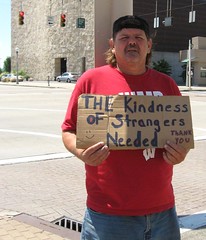
Photo #34: The kindness of strangersImage by elycefeliz via FlickrI read a blog post at Platonic Trip a while back that has stayed with me, kind of like a splinter that I just haven't been able to dig out. Its been irritating me beyond measure!

The gist of the post is that the writer was amongst a group of people approached by a man asking for money to buy medicine for his sick kids. Only one member of the group gave any money. The writer of the post outlined his reasons for not giving. According to his way of thinking the man asking for the money should have gone to the Church, or some Government agency to ask for help rather than bail up a group of individuals and try to emotionally blackmail them into helping him and his family out. The writer felt that there was no point in helping the man as he should have gone elsewhere to get the money he needed and drew the conclusion that kindness is a weakness and therefore not a virtue worth pursuing.

This post bothers me on many different levels.

I am not a fan of being approached by people in need asking me for money. It makes me feel uncomfortable. I like to have time to consider my options, to feel that I am not being taken advantage of. Giving in a face to face manner makes me anxious - I worry that I am not giving enough, or I'm giving too much, or I'm not being effective in my giving by giving directly to an individual. Given all this, I can relate to the fact that the writer of the post wasn't thrilled at being approached by the man asking for money.

However, his reasons for not giving seem shallow and badly thought out.

Don't get me wrong, I don't think it is a bad thing to not give money in situations like this. Many people are on limited or fixed incomes themselves and don't have spare for spontaneous giving. And the writer is correct, there are agencies and institutions in most countries that are set up to help people in just these circumstances. I'm sure the man in need could have visited them.

Perhaps he didn't know where to go? Rather than simply ignore him and his story, perhaps someone could have shown him a kindness and pointed him in the right direction to get help?

Was it really emotional blackmail appealing to the kindness of strangers in a time of need? I'm not advocating that anyone hand their life savings over to the first desperate sounding stranger with a sob story that approaches them, but surely, if you have a little money (time, food, other appropriate item) spare would it really hurt to share? Even if it does make you anxious or uncomfortable?

While his reasons for not giving disappoint me, the writer's conclusion that kindness is a weakness gobsmacks me.

Kindness is not the same as naivety. Its not blindly giving to everyone who asks, its not meekly accepting other people's bad behaviour, or unquestioningly believing whatever you are told.

Kindness is about choosing to make cups of tea for angry people because you know that your actions will make a difference. Its about being generous when you can do so, and respectfully saying no when you feel it is inappropriate or simply not possible. Kindness is about being strong and standing up for what you believe in, about being respectful and assertive. Kindness is about cultivating connections with others and building community.

Kindness would have to be one of my favourite virtues. It shows real strength of character.

post signature.

Reblog this post [with Zemanta]

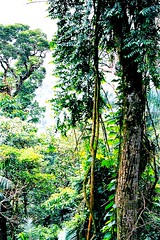
Birdwatching in the Atlantic Forest

Broadcasting Live with Ustream.TV


Earlier in the year (with a little help from my readers!) I adopted SALVEASERRA as my blog charity project. Any revenue generated from How to Make a Difference is donated to SALVEASERRA to help them continue their great work restoring the Atlantic Forest in Brazil.

You can help by downloading and using our toolbar, or purchasing a fantastic organic cotton t-shirt from WE ADD UP.

post signature

Reblog this post [with Zemanta]

27 November 2008

The Best Way to Save the World is to Save Yourself

AgricultureImage via Wikipedia
The best way to save the world is to save yourself. Sweep your own doorstep. Tend your own garden. Always do what you've agreed to do. Never take anything that's not yours. Be generous, but sceptical, kind, but not naive.
- The Daily Reckoning Australia
Poverty, violence, hunger, war, global warming, religious intolerance, terrorism . . . the problems of the world may seem big, but the solutions to them are small. They start with one person, you. They start with simple actions, the kind of things that you, and I , can do everyday. Grand gestures are exciting, but its the little things that really count. Their effects ripple out from our own lives and make a difference in the lives of others.

  1. Put your money where your mouth is
    Live by your values. Its easy to complain, its easy to throw up your arms in horror. But if you want to make a difference you need to have the courage of your convictions and you need to take action. Stand up for what you believe in.

  2. Do less
    Sometimes less really is more. Spend less time talking and more time listening to others. Make a point of consuming less. Use less resources. Drive less and walk or cycle more. Eat less meat. Slow down and enjoy life.

  3. Value the things you have
    Do you really need more Stuff? Do you need a new car, a bigger house, another TV? For many of us more stuff means more debt. And more debt means less time and more stress. Appreciate the things you already have.

  4. Build relationships
    People are more important than things. Really! Make your life's focus more about people and less about Stuff. Cultivate your friendships, treat everyone you meet with respect, be kind.

  5. Share what you have
    If any one thing can make a difference to the world then it has to be generosity. It doesn't have to be on a huge scale - we can't all give like Bill Gates. Be generous with your love, your time, your possessions, your money. Giving generously creates a feeling of abundance. It makes us less afraid of what we might lose, it builds community and connects people, it creates opportunity.

post signature

Reblog this post [with Zemanta]

25 November 2008

Mataura Makes the News


This evening Cambell Live aired Mataura's story about how a wealthy American dentist brought up our town after the local paper mill closed and has since let it fall into disrepair.

Given that we only had a five minute slot, I think Natasha Utting and the rest of the team involved in editing the story did a great job. You can watch the video at the Campbell Live Website.

It is already creating debate and discussion in the community, which is fantastic. And the timing is wonderful as well. We have a Community Planning Meeting coming up this Saturday and it will be a great forum to discuss the future direction of our town.

post signature

Reblog this post [with Zemanta]

23 November 2008

Good News for the Atlantic Forest

A bit, in colors, of the Atlantic Forest - Bra...Image by de Paula FJ via Flickr
Brazil moves to protect and restore endangered Atlantic rainforest
mongabay.com
November 22, 2008

Brazilian president Luiz Inacio Lula da Silva has signed a decree to protect and restore critically endangered rainforest along the country's Atlantic coast, reports the Associated Press.

The Mata Atlantica has been reduced to less than 7 percent of its original range as a result of logging and conversion for agriculture and cattle ranches.

The decree, signed Friday, "provides financial incentives for local residents to protect and recover forest through green businesses," according to the AP.

Carlos Minc, the country's Environment Minister, said the government aims to restore the Atlantic forest to 20 percent of its original cover.

Earlier this year the Nature Conservancy announced a program to plant a billion native trees in the region, in hopes of restoring the ecosystem. Research published last year suggests that with such efforts the Mata Atlantica may be capable of recovery.

Earlier in the year (with a little help from my readers!) I adopted SALVEASERRA as my blog charity project. Any revenue generated from How to Make a Difference is donated to SALVEASERRA to help them continue their great work restoring the Atlantic Forest in Brazil.

You can help by downloading and using our toolbar, or purchasing a fantastic organic cotton t-shirt from WE ADD UP.

post signature


Reblog this post [with Zemanta]

19 November 2008

Mataura Fights Back

Some time back I wrote a post Shame on You Dr Jack Phillips!! Give Us Back Our Town!! about how my home town, Mataura is being held to ransom by a foreign investor who is letting our main street fall into disrepair and stifling our community.

Today I spent the afternoon with Campbell Live's Natasha Utting doing a piece for national television on the difficulties Mataura is facing. It is such an exciting development and it has spurred Dr Phillips on to great things. Since Natasha contacted him last week to organise an interview he has had his staff out in full force sprucing up the town.

The broken window panes on the movie theatre have been repaired finally - after being broken for months. Buildings on the main street were being painted as we filmed today. We even saw workers tending to the interior of one building.

And the story hasn't even aired yet!

Here's hoping that this is just the nudge Dr Phillips needed to remember that with his rights as a property owner - and the major property owner in our town - come some responsibilities to the community. Hopefully now he will start some kind of dialogue with the Mataura Community to form a realistic, fair and community centred vision for Mataura that will benefit all parties involved!


post signature


Reblog this post [with Zemanta]

10 November 2008

Community Matters

To what extent do participants in joint activi...Image via WikipediaThe current economic instability seems to be encouraging an increasing realisation that we need to move on from the hedonistic, consumption focus that got us all into our current mess and embrace a more sustainable, community based model for living.

Unfortunately its not as easy as it sounds. The art of building community has been sorely neglected - if not actively discouraged - in many places and healthy communities don't just happen because people finally realise that we need them. They take work. They need active citizens willing to get involved in community initiatives and prepared to participate in the decisions being made that will affect their neighbourhoods, families and livelihoods.

If we want to rebuild Community, we need to understand that our rights as property owners, business people and community citizens come with responsibilities. It is our obligation to be actively involved in the well being of our neighbourhood. Whether that is standing for office in Local Government, being a contributing member of the local school community or making an effort to attend community events.

When we choose not to take an active role in our community, and hand decision making power over to Government, big business, foreign investors or even just let it concentrate in the hands of a select few of our neighbours then our communities wither and die. In a healthy community, people feel that they are listened to, they know they are valued, they are empowered and they have control over their collective destiny.

We need to realise that working for the common good doesn't undermine our rights as individuals, it strengthens them. Building Community isn't about some people having less so that others can have more, its about making sure that everyone has enough and that all our needs are met. In a healthy community those who can look after themselves and contribute to the community do so, and those who can't are respected and supported.

Strong communities offer support when times are tough. They advocate for the weak. They take care of their own. Because of this they are resilient. Because when it comes down to it self-reliance is a cooperative activity. In order to survive comfortably in hard times going it alone just doesn't work, instead we need to build and nourish our community connections.

post signature

Reblog this post [with Zemanta]

08 November 2008

Shop Local - Think Global

Main Street, Harrodsburg, KentuckyImage by lumierefl via FlickrIf you have aspirations to Make a Difference, but are hamstrung by indecision about where to start, who to support or how to put your money where your mouth is, consider starting local.

Supporting your community, neighbourhood and local economy makes a huge difference, and the effects don't just stop at your backyard, by keeping your focus local you can have a global impact. See the list below to find out how living local can positively impact you, your community and the world:

  1. Reduce Greenhouse Gas Emissions
    Goods that are locally made or grown don't have to travel so far to get from the producer to you. According to the World Watch Paper "Home Grown: The case for local food in a global market" a basic diet consisting of imported ingredients can use around four times the energy, and generate four times the greenhouse gas emissions, of an equivalent diet from local ingredients.

  2. Keep your Money LocalTown of Carrboro, North Carolina
    A study by the Independent Business Alliance in Austin, Texas found that for every $100 spent at local businesses $45 went back to the community. By comparison, for every $100 spent at a Chain Store, only $13 stayed in the community. This money helps to create jobs, supports local producers and raises local incomes.

    On a global scale, for developing nations, a focus on local production and local markets ensures that people are fed, that precious foreign exchange stays in the country, and that they are not so dependent on fickle international
    markets.

  3. Reduce Waste & Pollution
    Products that travel long distance need extra packaging for the journey. Food is treated with preservatives and additives so it lasts the distance. Local products don't need this extra, and locally grown food is fresher, tastier and healthier.

    Industrial agriculture is chemical and energy intensive. It pollutes our land and our water ways. Greedy global corporations focused on profit exploit workers in sweatshop conditions. Local producers working for local markets are more accountable to their communities. They are not focused on constant growth, and work within a more sustainable economic model.

  4. Encourage Crop Diversity
    Industrial farms like economies of scale. Its easier and more 'efficient' to grow one variety of carrot than half a dozen. Its much easier to just grow carrots instead of carrots and potatoes and broccoli and tomatoes. Industrial farms growing for export grow food that will travel well and still look the part when it gets where its going, and that isn't necessarily the best tasting or most nutritious variety.
    Exotic varieties of maize are collected to add...Image via Wikipedia
    Local farmers producing for local markets can grow what their customers want to buy. They can grow varieties of fruit or vegetables that suit local conditions, which reduces the amount of chemicals used on the crops. According to Home Grown "diverse organic and ecological farms, which rely less on purchased inputs and more on taking advantage of the ecological processes in the field, cost less to maintain and make more efficient use of land, nutrients, energy, and otherinputs, than do chemical-intensive monocultures."

  5. Fair Made-Traded-Grown
    Producing for the local market cuts out the middlemen that eat into producers income. In America studies have shown that farmers only get 20 cents of each dollar Americans spend on food. The other 80 cents is gobbled up by packaging, transportation, processing and advertising. So buying local, from local farmers, businesses, and producers means they get a fair price for their hard work - and you still get things cheaper!!

post signature


Reblog this post [with Zemanta]

03 November 2008

5 Ways to Create Abundance in an Economic Downturn

One of several versions of the painting Image via WikipediaNow, I know its a little early to be thinking of Christmas already, but this evening I was somewhat troubled to hear a national news broadcast trumpeting Christmas Misery ahead for New Zealanders on the back of the decreasing value of the New Zealand Dollar. Apparently we are all doomed to a miserable Christmas because the prices of imported goods are due to rise as our purchasing power diminishes.

Sure, times are tough, the economy is unstable, people are losing their jobs & their homes. Its frightening. However, this kind of foolish media scaremongering really irritates me. It helps the recession take a hold in people's minds by creating a mindset of scarcity and fear. It encourages people to focus on what they don't have, or can't afford rather than encouraging us to be creative with what we do have. It focuses our attention on stuff rather than on people.

Not being able to afford to purchase expensive presents at Christmas time is surely not the most newsworthy aspect of the current economic crisis. In fact, the kind of rampant, foolish consumerism that it represents is part of the cause of our current woes.

Here's a few tips to help you create a mindset of abundance amidst the economic chaos:
  1. Decide what is Important
    Take time to think about the things that you value most. Make a list of the 4 or 5 most important things and focus on keeping them in order. Simplifying your life in this way, paring it back to the essentials, helps you to appreciate what you do have and stop striving for stuff that ultimately has no value to you.

  2. Build Community
    Get to know your neighbours, the other parents at your kids school, your work colleagues. Build a network of people that you can share with when the going gets tough. Knowing that you are part of a community that has got your back can definitely help ease the fears brought on by the current economic instability.

    Check out 5 Ways to Rebuild your Neighbourhood
    for community building ideas.

  3. Be Generous
    At times like this its often our natural reaction to hoard - time, money, possessions. But in tough economic times, generosity is more important than ever. Have you ever noticed how the most generous of people never seem to be without the things that really matter?

    Read more about how generosity creates abundance at Digital Philanthropy

  4. Appreciate Sufficiency
    It sounds trite, but with our busy lifestyles we often forget to be thankful - taking a moment out of each day to be grateful can help you to realise how much you really have and what is important. Appreciating sufficiency - deciding how much is enough - can help the spectre of recession lose its power to make you fearful.

    Read 5 Ways to Help You Say 'Enough' for more inspiration.

  5. Be Proactive
    Don't sit back waiting for this latest economic crisis to make your life difficult. Take positive action now to recession proof your life as much as you are able. Start a vege garden, tackle any consumer debt, work on developing good financial habits, support your local economy, get into the habit of driving your car less . . . be positive and creative as you take stock and prepare for the future.


post signature

Reblog this post [with Zemanta]

01 November 2008

And the Winner is . . .

Wow, its November already. Time to announce the winner of our October Giveaway!

Melissa (from Operation Nice) won a copy of the fantastic book 'New Day Revolution' by Sam Davidson & Stephen Moseley - the duo that launched CoolPeopleCare.org


This month you can snag yourself a super WE ADD UP Plant Trees T-Shirt.

All you need to do it download the How to Make a Difference toolbar before the 15th of November. We'll send an alert to our toolbar users with further instructions on the 16th . . . Ooooh the suspense!!

You can download our toolbar here.

post signature

Reblog this post [with Zemanta]