Showing posts with label local economy. Show all posts

28 August 2010

5 Reasons to Enjoy Local Food

farmers market.jpg
Photo by MattSkal
At the heart of our market thinking is the idea that consumers will always act in their economic self interest, and will always procure goods from the lowest cost producer.  In our current world, that can leave our local economy in shambles.
. . .
Although we can put up protectionist trade barriers and cry foul over working conditions and lax environmental regulations in our competitors lands, the reality is that this is how we like it.  The free hand of the market is working great.  It is in our best interest to get cheaper goods, and voila, we are awash with cheap stuff.

- From "Small is Possible: Life in a Local Economy " by Lyle Estill


Surely food must be at the very heart of sustainable living.  What we eat, how we produce our food and where we get it from affects ourselves, the environment and our communities.  Our food choices affect everything from deforestation in the Amazon, to the accumulation of fast-food litter in our streets, to our individual health and wellbeing.  And it isn't just the food itself we need to think about, but how it is transported, packaged, prepared, and sold.  When you take all that into consideration, the true cost of your groceries could be well above the price you pay at the supermarket.
Here's just a few reasons why going out of your way to eat local is worth doing:
  1. It tastes better
    What could possibly be more delicious than freshly picked fruit and vegetables?  When you buy locally you know that your produce hasn't been sitting in a warehouse for months or endured kilometres of travel to reach you.
  2. Its healthier
    Food produced locally is fresher, more nutritious, less likely to contain additives and preservatives.  Not only that, but you can make sure you are buying food that isn't grown using unhealthy chemicals that also damage the environment.
  3. It helps you stay in touch with the seasons
    Believe it or not apples don't grow all year round, strawberries only grow in summer, and leeks are best in the late autumn and early spring (at least where I come from they are!).  Eating local food helps keep you in tune with nature's cycles.
  4. It helps you support your local economy
    By buying from local producers you keep your money in your community longer.  You create local jobs and a stronger sense of community.
  5. It helps you get to know your neighbours
    Buying local helps you get to know your neighbours, and your neighbourhood.  You get to experience new flavours, meet new people, and see new places.

Enhanced by Zemanta

29 June 2010

Wendell Berry’s 17 Rules For A Sustainable Economy

"A proper community, we should remember also, is a commonwealth: a place, a resource, an economy. It answers the needs, practical as well as social and spiritual, of its members - among them the need to need one another. The answer to the present alignment of political power with wealth is the restoration of the identity of community and economy.
(pg. 63, "Racism and the Economy")"
Wendell Berry (The Art of the Commonplace: The Agrarian Essays of Wendell Berry)

Wendell Berry is an American poet, novelist, essayist, philosopher and farmer.  He was born on August  5 1934 in Henry County, Kentucky, where he still lives and farms on the family farm.

He is a strong defender of family, rural communities, and traditional family farms. He has developed  these 17 rules for the healthy functioning of sustainable local communities:

1. Always ask of any proposed change or innovation: What will this do to our community? How will this affect our common wealth.

2. Always include local nature – the land, the water, the air, the native creatures – within the membership of the community.

3. Always ask how local needs might be supplied from local sources, including the mutual help of neighbors.

4. Always supply local needs first (and only then think of exporting products – first to nearby cities, then to others).

5. Understand the ultimate unsoundness of the industrial doctrine of ‘labor saving’ if that implies poor work, unemployment, or any kind of pollution or contamination.

6. Develop properly scaled value-adding industries for local products to ensure that the community does not become merely a colony of national or global economy.

7. Develop small-scale industries and businesses to support the local farm and/or forest economy.

8. Strive to supply as much of the community’s own energy as possible.

9. Strive to increase earnings (in whatever form) within the community for as long as possible before they are paid out.

10. Make sure that money paid into the local economy circulates within the community and decrease expenditures outside the community.

11. Make the community able to invest in itself by maintaining its properties, keeping itself clean (without dirtying some other place), caring for its old people, and teaching its children.

12. See that the old and young take care of one another. The young must learn from the old, not necessarily, and not always in school. There must be no institutionalised childcare and no homes for the aged. The community knows and remembers itself by the association of old and young.

13. Account for costs now conventionally hidden or externalised. Whenever possible, these must be debited against monetary income.

14. Look into the possible uses of local currency, community-funded loan programs, systems of barter, and the like.

15. Always be aware of the economic value of neighborly acts. In our time, the costs of living are greatly increased by the loss of neighborhood, which leaves people to face their calamities alone.

16. A rural community should always be acquainted and interconnected with community-minded people in nearby towns and cities.

17. A sustainable rural economy will depend on urban consumers loyal to local products. Therefore, we are talking about an economy that will always be more cooperative than competitive.


post signature

27 November 2009

Book Review: Small is Possible:Life in a Local Economy

Cover of "Small is Possible: Life in a Lo...Cover via Amazon

I loved Lyle Estill's "Small is Possible: Life in a Local Economy". It's a fun, inspiring collection of stories from Chatham County, the author's home town. It chronicles the successes and failures of the resident's attempts to build a sustainable, local economy and thriving community.

The large collection of characters at times seemed to rival War and Peace in complexity. I occasionally had to flick back to remind myself who was who, which interrupted the flow a little.

I'm involved in my own town's attempts to build community and rebuild our local economy. I find it both fascinating and disturbing that for many people here the idea of a thriving town means 'growth' and the idea of a local economy, supporting and supported by a local community is swept aside in the quest for bigness, progress and outside intervention (from big government or big business).

The book hinted at times that there was another side of the community in Chatham County that is perhaps less interested in the possibilities of small and I would loved to have heard more about the context into which the attempts at local sustainability fit.

All in all, a compelling read for anyone interested in sustainable, local living and building community!

post signature

Reblog this post [with Zemanta]

31 May 2009

Do Your Home Work

I was reading this great article form Yes! Magazine today - 31 Ways to Jump Start the Local Economy. I've come away feeling all inspired.

The ideas aren't earth shattering. As my venerable father commented, if we looked back to the time when he was growing up, many of the suggestions in the article, such as buying less, fixing things, putting down roots and being part of the community, were the norm.

My favourite idea is:
Do home work parties. Each month, go to a different household to do major home greening, a garden upgrade, or some deferred maintenance.

I can see that would be such a positive and uplifting thing to do in Mataura. The town is a little bit run down, and people don't have a whole lot of money. I would love to pull together some funding and help people to fix their homes, tidy their gardens and make the town look a little more loved. It would help create such a sense of pride in our town and community spirit.

I don't want to give you the wrong idea about Mataura. We have plenty of beautiful homes with well kept gardens that people obviously take pride in.

Wouldn't it be great if all the homes could look like that? And rather than bemoaning the fact that some people can't, or won't, maintain their houses why don't we step in as a community and help each other out?

post signature

Reblog this post [with Zemanta]

28 January 2009

McDonalds is Coming to Town

Ronald McDonaldImage via Wikipedia

Yes, its true. The Golden Arches are coming to Gore and will be peddling their wares 24 hours a day, 7 days a week.

According to the McDonalds New Zealand website McDonalds restaurants spend around $100 million a year with Kiwi suppliers - in fact some 90% of the products they use in their restaurants are sourced in New Zealand and 80% of their restaurants in this country are owned by New Zealanders. They employ over 6000 staff throughout New Zealand. Which all sounds good . . . right?

Obviously having a McDonalds in town will not be without benefits to some local businesses. They will need tradesmen for maintenance and repair, they will encourage more visitors into Gore - the closest McDonalds around is a good 40 minutes drive South in Invercargill, and they will employ more people in the town. . . mostly at the bare minimum wage of $12 per hour.

McDonalds workers who are member of the UNITE Union of Workers have recently won a settlement that will, from March 2009, increase the base level of pay for a crew member from $12 per hour to $12.50 and allow them some level of shift security. It has been a hard won fight - and despite the McDonalds Corporation posting significant profits recently, it took 50 strikes by union workers before McDonalds would come to the party. Is this really the kind of employer we want to encourage into our community?

Now, McDonalds is not the first fast food giant to land in town. We have Pizza Hut, KFC and Subway currently gracing our main street, so we are already spoiled for choice when it comes to fast food joints that add little value to the local economy. Do we really need another? Surely it would be wiser as a community to support the local eateries that spend their money here in town?

Although McDonalds have , in recent years, begun to offer healthier choices on their menu, ultimately what they sell is junk food. In fact, what they sell is more junk than food - and I'm not just talking about the poor nutritional value of their products. Fast food outlets are fantastic producers of waste - from unnecessary packaging to food waste.

In the UK McDonalds is responsible for 29% of the fast food rubbish that litters the country's streets. Here in New Zealand, Wanganui Mayor Michael Laws is considering a levy on fast food corporates because the Wanganui Council feel it is unfair that ratepayers should have to pay to clean up their packaging litter. In Gore the local council has stipulated as part of the resource consent granted to McDonalds that they need to install extra rubbish bins around their restaurant. But unfortunately, many fast food consumers don't eat on site and throw their rubbish elsewhere.

Of course, you can't hold McDonalds responsible for their customers being too lazy to properly dispose of their rubbish. But, the fast food mentality - the eating in a hurry, the sacrificing your body's nutritional needs, the generic food and service . . . if you can't take the time to eat mindfully and fuel your body well, then why would you take the time to put your rubbish in the bin?

I'm all for encouraging business into our area of the world. In fact, I am actively involved in trying to build up the local economy in Mataura, where I live, just out of Gore. But I think that we need to be more choosy about the type of businesses we encourage into our communities. We need to be looking for businesses that will strengthen our local economies, that impact positively on the environment, that offer fair wages for a days work, that sell products that contribute to our wellbeing. . . I don't feel that our new McDonalds will do any of this.

post signature

Reblog this post [with Zemanta]

10 December 2008

Mataura is For Sale

Since TV3's Campbell Live story aired a couple of weeks ago, Dr Jack Phillips has put several of his commercial properties in Mataura up for sale.

There are 4 shops for sale on Bridge St, and the movie theatre on the main highway is also for sale.

I like to think it was something I said . . . but I have a sneaking suspicion that he has had plans afoot for a little while. Either way, it certainly gives Mataura a chance at a new lease on life and it couldn't have happened at a better time. There is so much going on in Mataura in the aftermath of our Community Planning day.

I am involved with a group of people working to set up a Co-Op and to foster business development in Mataura. We have a meeting tomorrow with David Wilson - a rural change consultant (and penny farthing enthusiast!) - to discuss the way forward. We will definitely be needing a premises at some time in the future and its nice to know that if we can find the funding there are buildings available for purchase on our main street. Fantastic!!

Any investors out there with a real community based vision willing to invest in our town?

post signature

Reblog this post [with Zemanta]

10 November 2008

Community Matters

To what extent do participants in joint activi...Image via WikipediaThe current economic instability seems to be encouraging an increasing realisation that we need to move on from the hedonistic, consumption focus that got us all into our current mess and embrace a more sustainable, community based model for living.

Unfortunately its not as easy as it sounds. The art of building community has been sorely neglected - if not actively discouraged - in many places and healthy communities don't just happen because people finally realise that we need them. They take work. They need active citizens willing to get involved in community initiatives and prepared to participate in the decisions being made that will affect their neighbourhoods, families and livelihoods.

If we want to rebuild Community, we need to understand that our rights as property owners, business people and community citizens come with responsibilities. It is our obligation to be actively involved in the well being of our neighbourhood. Whether that is standing for office in Local Government, being a contributing member of the local school community or making an effort to attend community events.

When we choose not to take an active role in our community, and hand decision making power over to Government, big business, foreign investors or even just let it concentrate in the hands of a select few of our neighbours then our communities wither and die. In a healthy community, people feel that they are listened to, they know they are valued, they are empowered and they have control over their collective destiny.

We need to realise that working for the common good doesn't undermine our rights as individuals, it strengthens them. Building Community isn't about some people having less so that others can have more, its about making sure that everyone has enough and that all our needs are met. In a healthy community those who can look after themselves and contribute to the community do so, and those who can't are respected and supported.

Strong communities offer support when times are tough. They advocate for the weak. They take care of their own. Because of this they are resilient. Because when it comes down to it self-reliance is a cooperative activity. In order to survive comfortably in hard times going it alone just doesn't work, instead we need to build and nourish our community connections.

post signature

Reblog this post [with Zemanta]

08 November 2008

Shop Local - Think Global

Main Street, Harrodsburg, KentuckyImage by lumierefl via FlickrIf you have aspirations to Make a Difference, but are hamstrung by indecision about where to start, who to support or how to put your money where your mouth is, consider starting local.

Supporting your community, neighbourhood and local economy makes a huge difference, and the effects don't just stop at your backyard, by keeping your focus local you can have a global impact. See the list below to find out how living local can positively impact you, your community and the world:

  1. Reduce Greenhouse Gas Emissions
    Goods that are locally made or grown don't have to travel so far to get from the producer to you. According to the World Watch Paper "Home Grown: The case for local food in a global market" a basic diet consisting of imported ingredients can use around four times the energy, and generate four times the greenhouse gas emissions, of an equivalent diet from local ingredients.

  2. Keep your Money LocalTown of Carrboro, North Carolina
    A study by the Independent Business Alliance in Austin, Texas found that for every $100 spent at local businesses $45 went back to the community. By comparison, for every $100 spent at a Chain Store, only $13 stayed in the community. This money helps to create jobs, supports local producers and raises local incomes.

    On a global scale, for developing nations, a focus on local production and local markets ensures that people are fed, that precious foreign exchange stays in the country, and that they are not so dependent on fickle international
    markets.

  3. Reduce Waste & Pollution
    Products that travel long distance need extra packaging for the journey. Food is treated with preservatives and additives so it lasts the distance. Local products don't need this extra, and locally grown food is fresher, tastier and healthier.

    Industrial agriculture is chemical and energy intensive. It pollutes our land and our water ways. Greedy global corporations focused on profit exploit workers in sweatshop conditions. Local producers working for local markets are more accountable to their communities. They are not focused on constant growth, and work within a more sustainable economic model.

  4. Encourage Crop Diversity
    Industrial farms like economies of scale. Its easier and more 'efficient' to grow one variety of carrot than half a dozen. Its much easier to just grow carrots instead of carrots and potatoes and broccoli and tomatoes. Industrial farms growing for export grow food that will travel well and still look the part when it gets where its going, and that isn't necessarily the best tasting or most nutritious variety.
    Exotic varieties of maize are collected to add...Image via Wikipedia
    Local farmers producing for local markets can grow what their customers want to buy. They can grow varieties of fruit or vegetables that suit local conditions, which reduces the amount of chemicals used on the crops. According to Home Grown "diverse organic and ecological farms, which rely less on purchased inputs and more on taking advantage of the ecological processes in the field, cost less to maintain and make more efficient use of land, nutrients, energy, and otherinputs, than do chemical-intensive monocultures."

  5. Fair Made-Traded-Grown
    Producing for the local market cuts out the middlemen that eat into producers income. In America studies have shown that farmers only get 20 cents of each dollar Americans spend on food. The other 80 cents is gobbled up by packaging, transportation, processing and advertising. So buying local, from local farmers, businesses, and producers means they get a fair price for their hard work - and you still get things cheaper!!

post signature


Reblog this post [with Zemanta]

25 September 2008

Shame on you Dr Jack Phillips!! Give us back our Town!!

I live in a small town. Its almost at the very bottom of New Zealand on the main road between North and the little bit of South that is left before you hit the sea.

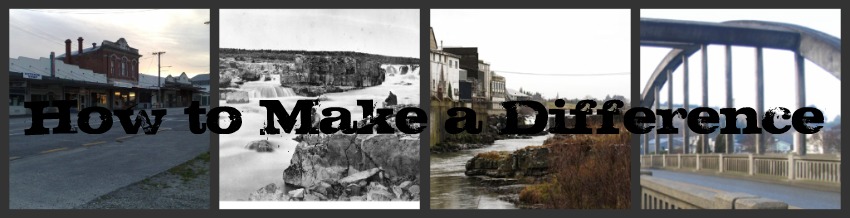
We are on the edge of what is a beautiful river. Unfortunately in the 1800's someone got the great idea to build an abattoir and a paper mill along side of the river (and blast the impressive Mataura Falls to oblivion while they were at it). So Mataura is a working class town, definately more industrial than picturesque.

In the past it has been a very important town - it had the only bridge across the river for miles around. Then they built the railway on 'the other' side of the river and our bridge didn't matter so much anymore.

But the Mill and the Abattoir kept the town humming. They both employed a lot of people. We had our own council and a main street full of busy shops.

Then 8 years ago the Mill closed (the work went overseas) and the town died. The people just gave up, they abandoned homes and businesses. The community spirit died too. The council amalgamated with Gore, a nearby town and Mataura no longer runs its own affairs.

An American investor, a retired dentist by the name of Dr Jack Phillips, who owned properities in beautiful Queenstown and in Gore, took the opportunity to buy the town centre. He owns all but a few of the commercial buildings in our main street. He owns the cinema, he owns the squash club, he owns a church, a masonic lodge building and all are unused. He brought them cheap from people who saw no future for themselves after a devastating and unforseen loss of industry and jobs. Apparently he has a vision for our town.

So far it seems to involve a deserted main street of increasingly dilapidated buildings and charging rents for said neglected buildings that are more in keeping with those charged in a busy urban centre. In fact, thus far it seems to involve actively discouraging potential businesses from starting up in Mataura.

Dr Jack Phillips does not live in New Zealand (that's ok - lots of people don't its not their fault!) and he does not live in Mataura. He comes here for a couple of weeks each year (I believe that is a requirement of holding property in this country if you are a foreign national) to oversee his investments.

His 2008 visit has just drawn to a close and he has finally let us in on what his grand vision for our town actually is. He plans to turn Mataura into a boutique town, with art galleries and antique stores. Sounds lovely? How many boutique towns do you know with a freezing works as the focal point?

Mataura is a town with a lot of social problems. People here are poor. We have the most needy school in the whole of Southland - kids turn up to school with no breakfast. Illiteracy is a BIG issue in our town. So is alcoholism and despair. People in Mataura do not need art galleries and antique stores. We need a green grocer, a dentist, a cafe, a hair dresser, recreational facilities to keep the kids off the streets, a bakery. We need practical stuff.

The Squash Club could be up and running - it is a relatively new building and when last used was all in good repair. But Jack Phillips wants to turn it into a gym, so we miss out. The Movie Theatre has all it needs to be operational and could run quite nicely as a small town theatre. But Dr Jack Phillips wants to turn that into an art studio, so once again we miss out.

His vision for our town has not been formed in consultation with the people that live here. In fact if it were to go ahead, many of the people that live here now would not be able to afford to stay. Where are they supposed to go? Many of them have lived here all their lives.

How can a foreign investor, who does not live in New Zealand, let alone in Mataura, come to own the majority of this small town and decide unilaterally what the direction of our community is to be?

SHAME ON YOU Dr. JACK PHILLIPS!!! GIVE US BACK OUR TOWN!!!

post signature

Reblog this post [with Zemanta]

04 August 2008

Lets Take Responsibility

Interstate 80 (Eastshore Freeway) in Berkeley,...Image via Wikipedia Lately I've been hearing a lot of people complaining about the state of the world today. About the rising costs of petrol and groceries, about increased crime and violence, about environmental degradation, about unemployment, how their neighbourhood isn't what it used to be, about the crazy traffic on our roads . . . now don't get me wrong, its not that I don't think these things warrant a grizzle. Its just that the majority of people I hear complaining are blaming it all on someone else - Government, big business, immigrants, terrorists, the rich and powerful - as though they have no personal responsibility for the problem and therefore no responsibility to contribute to the solution.

Its so easy to blame McDonalds for making us overweight rather than accepting responsibility for our own poor diet choices. Or to blame credit card companies for drowning us in debt rather than accepting responsibilty for our own bad spending habits. Or to blame the loss of local jobs on big business rather than on our lack of support for locally made goods

Its time to take a look at the choices we make as individuals and consider their consequences. If we choose to buy overpackaged products, then they will continue to be made. If we choose not to support our local economy, it won't thrive. If we choose to live outside of our means, we will get into debt. If we choose to support businesses that pollute our environment, they will continue to do so.

Its up to each one of us to start making informed and mindful choices about how we live our lives rather than sitting back and waiting for 'them' to fix things for us. Its up to each one of us to start now instead of sitting back and waiting for everyone else to do something - someone needs to be first . . . why not you??


Zemanta Pixie

14 July 2008

5 Ways to Rebuild Your Neighbourhood

A row of houses on Calea DudeştiImage via Wikipedia We live such disconnected lives nowadays. We commute long distances to work, we work long hours, we barely have enough time for our family let alone our neighbourhood. But by neglecting our most immediate community connections we lose an invaluable support network, we miss out on the opportunity to forge great friendships, to create a safe environment for our kids to play in and to have the sense of really belonging that comes with being a contributing member of the neighbourhood.

It seems that neighbourliness is a lost art. And it shows in the graffiti on fences and buildings, in the litter on the street, in the lonliness of people who live surrounded by other lonely people in our cities and towns. But its not so hard to be neighbourly. All it takes is to slow down a little and make an effort.

When was the last time you stopped to chat with someone who lives in your street? If its been a while, then perhaps its time to get to know your neighbours and rebuild your neighbourhood! Check out the list below for some ideas to get you started.

1. Be welcoming
It sounds corny, I know, but take the time to welcome new families to your neighbourhood. Think of the things that they may need to know - like when the rubbish is collected, if there are any neighbourhood playgroups or youth groups, where the local parks, libraries, recreation facilities are. You could even come up with a Welcome pack to present to new families with all that info.

2. Meet your neighbours
If you don't know the people that live around you, make a point of getting to know them. You could organise a get together for the neighbourhood in the local park, or simply make the effort to smile and say hello when you see people on the street.

3. Share with your neighbours
Share your skills, the bounty of your garden, your time, your possessions . . . it can take time to build a sense of trust but it has to start somewhere and it might as well be with you.

4. Encourage neighbourhood pride
Organise a group of neighbours to pick up litter from the sidewalk or to clean up the local park, take action to eliminate graffiti. It may only be a few of you at first, but its amazing the difference in people's attitude towards their neighbourhood once it starts to look like someone cares.

5. Support your Community
Support local business and recreation facilities, they can be a real rallying point and source of pride for your neighbourhood.


Reblog this post [with Zemanta]

17 May 2008

Website Round Up - Rebuilding your Local Economy

There are some great resources on the Web for anyone wanting to revive their local community. Here are a few to get you started. Enjoy!

Don't forget to vote in our Charity Poll! Click here to choose your favourite Charity.

14 May 2008

5 Ways to Make a Difference to your Local Economy

Supporting your local economy sounds like a quaint old fashioned idea these days. There is so much talk of the benefits of being involved in the Global Economy that it seems almost odd to question this prevailing view.

But is it really good for all of us? Is it in the best interests of our local communities that big business fights measures being put in place to preserve our local environments and employee rights? Is it really in our best interests that any profits made in our community are sent to head offices located in other cities or worse in other countries? Just who is it that is really benefitting here?

By supporting our local economy we build stronger communities. It encourages us to get to know our neighbours, to look after our neighbourhoods and to be more self reliant as a community.

Want to know how to support your local economy? Check out this list and start to make a difference in your neighbourhood today!

1. Eat Local
Try shopping at the local Farmer's Market. Its a great way to get fresh seasonal produce and to get to know your local producers. Or grow your own vegetables and swap your excess produce with the neighbours.

2. Shop Local
Support local, family owned businesses. It keeps local money local.

3. Invest Locally
Rather than send your money offshore by investing in Global Corporations, try investing locally. This way you can help support local organisations, individuals and entrepreneurs - and you know where your money is going. You can also be sure that you are investing with your values and directly benefitting your community..

4. Buy Local Renewable Energy
If you have the choice buy your energy locally from renewable sources such as wind farms. Better still invest in solar panels and generate your own..

5. Get Involved
Get to know your neighbours. Volunteer at local community groups. Stand for your local Council - or just attend the public meetings so you know what's going on. Read local newspapers. Join local clubs. Be an active member of your community!!


Use Buzzfuse* to easily rate, review, and share this item