
Showing posts with label Lyle Estill. Show all posts

01 September 2010

7 Ways to Finance Your Community

First National Bank of Orwell (1878) - marble ...Image by origamidon via Flickr"I believe the notion of financing ourselves is where we receive the lowest marks as a community - as perhaps it is the most difficult thing to do."

". . . we have allowed our financing to go global, which means our debt and our premiums are traded half way around the world, and we have largely lost our ability to influence them."

- From "Small is Possible: Life in a Local Economy " by Lyle Estill

I love the idea of communities financing themselves. The rise of big global banks and financial institutions has rendered money abstract, mysterious and impersonal.

What could be more real, open and personal than financing each other? Whether its with a local currency, barter, time banking or a community bank . . . there are so many ways that communities can take back some control over their local economy.

Check out these ideas for funding your community:

  • Start a neighbourhood home maintenance fund to help homeowners keep their homes in tip-top condition
  • Start a community bank which returns all profit to projects that benefit the community
  • Encourage local businesses to start a workplace giving programme to fund local charities and non-profit groups
  • Set up a community cultural foundation that encourages locals to contribute to help develop arts and culture in the community
  • Establish a local currency
  • Set up a time bank
  • Encourage locals to shop locally and support local businesses
post signature
Enhanced by Zemanta

28 August 2010

5 Reasons to Enjoy Local Food

farmers market.jpg
Photo by MattSkal
At the heart of our market thinking is the idea that consumers will always act in their economic self interest, and will always procure goods from the lowest cost producer.  In our current world, that can leave our local economy in shambles.
. . .
Although we can put up protectionist trade barriers and cry foul over working conditions and lax environmental regulations in our competitors lands, the reality is that this is how we like it.  The free hand of the market is working great.  It is in our best interest to get cheaper goods, and voila, we are awash with cheap stuff.

- From "Small is Possible: Life in a Local Economy " by Lyle Estill


Surely food must be at the very heart of sustainable living.  What we eat, how we produce our food and where we get it from affects ourselves, the environment and our communities.  Our food choices affect everything from deforestation in the Amazon, to the accumulation of fast-food litter in our streets, to our individual health and wellbeing.  And it isn't just the food itself we need to think about, but how it is transported, packaged, prepared, and sold.  When you take all that into consideration, the true cost of your groceries could be well above the price you pay at the supermarket.
Here's just a few reasons why going out of your way to eat local is worth doing:
  1. It tastes better
    What could possibly be more delicious than freshly picked fruit and vegetables?  When you buy locally you know that your produce hasn't been sitting in a warehouse for months or endured kilometres of travel to reach you.
  2. Its healthier
    Food produced locally is fresher, more nutritious, less likely to contain additives and preservatives.  Not only that, but you can make sure you are buying food that isn't grown using unhealthy chemicals that also damage the environment.
  3. It helps you stay in touch with the seasons
    Believe it or not apples don't grow all year round, strawberries only grow in summer, and leeks are best in the late autumn and early spring (at least where I come from they are!).  Eating local food helps keep you in tune with nature's cycles.
  4. It helps you support your local economy
    By buying from local producers you keep your money in your community longer.  You create local jobs and a stronger sense of community.
  5. It helps you get to know your neighbours
    Buying local helps you get to know your neighbours, and your neighbourhood.  You get to experience new flavours, meet new people, and see new places.

Enhanced by Zemanta

22 August 2010

Chasing Smoke Stacks

smoke stacks.jpg
Image by shodan

"Chatham Couny's economic development has been characterized by chasing smoke stacks around.  And its a shame that we don't tend to catch that many.
. . .
We did manage to land 3M.  It is the last plant that 3M will operate in America, and it came here.  Whew, I am  fortunate enough to live across the road from the 3M lands, and am pleased to report that all it cost us was our night sky and our silence.  Now when we weed our gardens we do so against a constant background rumble.  The sales of white noise machines must have plummeted at the Jordan Dam Mini Mart after 3M came to town."

- From "Small is Possible: Life in a Local Economy" by Lyle Estill


Where I live, we have - in the last 12 months - been blessed with a 24 hour McDonalds.  It has created 60 more jobs, more late night 'disturbances' for the police to attend to, more litter, more traffic, and one more junk food outlet.


My town sits on top of New Zealand's largest lignite deposit.  There was great rejoicing when Solid Energy moved in.  They have bought a lot of land - and bumped land prices up, increased employment somewhat, and have development plans in the works that could result in a significant employment boom as they dig huge, ugly scars in the landscape to extract one of the dirtiest fuels around.


Surely there have to be better development models for our communities than this?


post signature
Enhanced by Zemanta

08 August 2010

Is There Such a This as an Ethical Global Company?


"I was running a profitable, ethical corporation.  I was creating jobs.  I was generating wealth.  I stabbed no one in the back, saw no need to crush anyone below me, and if business is to be described as a “dog eat dog” activity, I had no occasion to “eat dog”.

My employees tended to stay with me for many years;  I won awards for workplace culture, for family friendly environments, and for waste reduction.  I had a disciplined program of charitable giving, and donated a percentage of my profits to local charities in the markets where the products were produced."
- From "Small is Possible: Life in a Local Economy" by Lyle Estill

Free trade areas are a difficult subject. It i...Free Trade is widely accepted worldwide as the prevailing economic theory.  In a nutshell, the theory says that free trade will increase efficiencies as each country produces what its best at.  This will drive down prices for consumers, who will spend more, which will boost business and will lead us ever onwards and upwards to bigger and better things.  The wealth of those at the top will 'trickle down' to those at the bottom and poverty will be eliminated.

In reality, while we have increasingly freer trade, its not fairer trade.  The wealth is getting concentrated at the top in the hands of the few.   Global poverty seems to be becoming more entrenched rather than being a thing of the past.

The economic theory doesn't seem to fit with reality.  While economies of scale may be being achieved, local economies, and the communities that relied on them, are being crushed.  The ecosystem that we rely on for our very existence as a species is being poisoned by businesses more focused on short term profit than long term sustainablity.  Culture is becoming increasingly homogenous around the globe and, as big business gets bigger, Governments are increasingly swayed from doing what's best for their citizens to doing what's best for business.

No matter how much global companies contibrute to local communities, or how well they treat their staff, at the very root of global trade is a theory that totally disregards the needs of human beings, our communities and our planet.

Is it really possible to be a truly ethical global company?


post signature

*Image via Wikipedia
Enhanced by Zemanta

27 November 2009

Book Review: Small is Possible:Life in a Local Economy

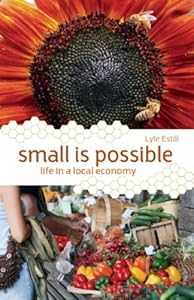
Cover of "Small is Possible: Life in a Lo...Cover via Amazon

I loved Lyle Estill's "Small is Possible: Life in a Local Economy". It's a fun, inspiring collection of stories from Chatham County, the author's home town. It chronicles the successes and failures of the resident's attempts to build a sustainable, local economy and thriving community.

The large collection of characters at times seemed to rival War and Peace in complexity. I occasionally had to flick back to remind myself who was who, which interrupted the flow a little.

I'm involved in my own town's attempts to build community and rebuild our local economy. I find it both fascinating and disturbing that for many people here the idea of a thriving town means 'growth' and the idea of a local economy, supporting and supported by a local community is swept aside in the quest for bigness, progress and outside intervention (from big government or big business).

The book hinted at times that there was another side of the community in Chatham County that is perhaps less interested in the possibilities of small and I would loved to have heard more about the context into which the attempts at local sustainability fit.

All in all, a compelling read for anyone interested in sustainable, local living and building community!

post signature

Reblog this post [with Zemanta]