Showing posts with label Poverty. Show all posts

29 March 2009

Earth Hour: Media Hype or Effective Awareness Building?

The Sky Tower in Auckland switched off lights ...Image via Wikipedia

I enjoyed my Earth Hour at home with a warm bath and some pleasant conversation with my husband. It was surprisingly relaxing to spend an evening without lights, tv or computer, but did it really make a difference?

In the long run, spending an hour in the dark once a year is unlikely to significantly reduce my carbon footprint, or impact climate change in a meaningful way. So does this mean its all just media hype?

Of course not! Earth Hour is about building awareness about climate change and how each of us can make choices that can help to reduce our impact on the planet. Its about how collectively we are powerful. Its about making us think about the things we do.

Earth Hour was a reminder for me about how much I take for granted. Lights that turn on at the flick of a switch, television, my computer, constant hot water, a hot drink in minutes, smoke free cooking (well most of the time!) . . .

For a quarter of humanity this is sheer luxury. Some 1.6 billion people live without electricity. In developing countries some 2.5 billion people are forced to rely on wood, charcoal and animal dung to meet their energy needs for cooking. Indoor air pollution resulting from the use of solid fuels claims the lives of 1.5 million people each year, more than half of them below the age of five: that is 4000 deaths a day.

Earth Hour made me think about the way my family and I consume resources as we go about our daily lives. There is a huge global disparity between the haves and the have-nots:
The 12 percent of the world’s population that lives in North America and Western Europe accounts for 60 percent of private consumption spending, while the one-third living in South Asia and sub-Saharan Africa accounts for only 3.2 percent (The State of Consumption)
By choosing to consume less - whether it be electricity, chocolate bars or petrol - we do something to even things up. By choosing to consume less and donating even a portion of the savings we make to charities that address global poverty we are doing even more.

What did Earth Hour mean to you?

post signature

Reblog this post [with Zemanta]

04 March 2009

Global Search for Innovation in Farming & Rural Communities

Ashoka’s Changemakers have announced the launch of a global, online competition to seek out the most innovative solutions in farming and rural communities iaround the world. The competition is funded as part of a grant awarded by the Bill & Melinda Gates Foundation.

Today, three quarters of the world’s poorest people—the 1 billion who live on $1 a day or less—live in rural areas, and most rely on agriculture for their food and income. Many small farmers cannot grow enough food to sell or even eat. Ashoka is seeking innovative solutions that will offer these hundreds of millions of the people the opportunity to overcome hunger and poverty.

Over the next two months, you can nominate those who are making a difference in farming and rural communities, or you can submit your own project.

At the end of this period a panel of judges will choose 10 to 15 finalists and the global Changemakers community will then vote for three winners, who will each receive a USD $5000 award from Changemakers to fund their initiatives. The finalists and winners will receive media attention and are showcased on the Changemakers website.

This is an incredible opportunity for all entrants to showcase their project and gain increased access to a global network of innovators, supporters, and investors with the means to help them fund and/or scale their projects.

You can nominate a project or submit your entry here.


post signature

Reblog this post [with Zemanta]

05 January 2009

Let's Make 2009 the Year for saying "No"

Protesters outside the Hotel Washington during...Image via Wikipedia

All the great men and women in the world have been people who, rather than say "Yes", said a very resounding "No" to everything that did not fit their ideal of bounty and growth.
- Paulo Coelho

There are a lot of things wrong in the world, from pointless wars and starvation amidst plenty, to a deepening recession and all the fear and uncertainty that entails.

Its easy to feel powerless in the face of it all, to shrug our shoulders and wonder what 'they' are going to do to fix it for us. But playing the victims isn't going to get us anywhere. We need to take action.

Lets make 2009 the year to lay claim to greatness and say 'No' to the things that don't fit our ideals of bounty and growth. Lets make this the year of standing up for what we believe in, being accountable and making a difference.

I'm not one for making New Year's resolutions, but here's a few things I'm saying 'No' to this year:

Deforestation
We need trees! They purify the air we breathe, provide habitats for countless varieties of flora & fauna, and they soothe the soul, amongst other things. Lets all say 'No' to chopping them down en masse so a few can make a transitory profit.

Whether its the Atlantic Forest, the jungles of Borneo or that patch of green on the edge of your neighbourhood, lets not stand by and let it happen in 2009!

You can say 'No' to deforestation in the Atlantic Forest by donating $2 here - and you go in the draw to win an awesome WE ADD UP 'Plant Trees' tee.

Greed
Lets make 2009 a year to exercise greed control. A recession is no place for selfishness and hoarding. Join me in saying a resounding 'No' to greed and fear and lets share what we have - time, knowledge, skills, money, possessions. Lets build strong communities, neighbourhoods where we support each other through the tough times ahead. Lets create hope, dignity and opportunity through our generosity.

Poverty
Almost half the world lives on less than $2.50 a day and at least 80% of humanity lives on less than $10 a day. That can't fit anybody's ideal of bounty and growth!

And lets not assume that poverty only happens overseas, to other people. There are people in our own communities who, for reasons beyond their control, don't have enough. Let's say a huge 'No' to that this year.

In our world of relative plenty there is no excuse for poverty, hunger, homelessness, hopelessness. We all have a responsibility to do something about it, in our own neighbourhood, in our own country and further afield. With a little generosity, kindness and a shift in our thinking of what is enough we can all create opportunities to lift others out of poverty.

Junk Food
McDonalds is moving in just up the road in Gore. I guess that means we are on the map. But junk food really just doesn't fit my ideal of bounty and growth. It is wasteful, creates vast quantities of rubbish, is less than nutritious and full of empty calories.

For many people junk food - and I don't just mean fast food, but processed food, soda, candy bars, ice-cream - has become a staple part of their diet. According to Dr. Scott Olson most people eat around 1/4-1/2 pound of sugar a day.

And its bad for us. All this junk. It makes us sick, and tired. Its not the food our bodies were made to run on.

So this year lets get back to eating food our Grandparents would recognise as food. More fruit, more vegetables, more wholegrains. Real food.

Lets say 'No' to corporations making money at the expense of our health and wellbeing by selling us junk and calling it food. Lets say 'No' to blindly following their advertising directives and take responsibility for choosing to spend our hard earned money on food that is good for us instead.

Stuff
How about we choose this year to stop accumulating stuff. Lets choose to define ourselves by our relationships to people rather than by the things that we own and the stuff we consume. Lets make do, buy second hand, opt for reusable rather than throw-away items, borrow from a neighbour, share, make our own . . .

The current economic climate is a marvellous excuse to explore the joys of frugality. Lets embrace it. Lets learn new skills to make the most of what we have.

Lets get out of debt, choose not to get into debt, live within our means. Think of the freedom, think of the choices we will have. Would you really work all that overtime rather than spend the time with your family if you didn't have to pay that huge mortgage for a huge house when a smaller house would do just fine? Does the latest fashion, the newest gadget, the shiniest appliance, the swankiest nick-nack really make your life more rewarding?

This year lets make a point of saying 'No' to stuff. Lets take our lives back, lets focus on the important things instead.

What's your resounding 'No' for 2009?


post signature

Reblog this post [with Zemanta]

30 November 2008

An Ounce of Kindness

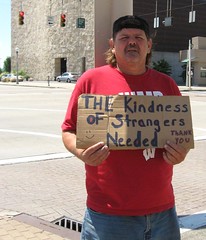
Photo #34: The kindness of strangersImage by elycefeliz via FlickrI read a blog post at Platonic Trip a while back that has stayed with me, kind of like a splinter that I just haven't been able to dig out. Its been irritating me beyond measure!

The gist of the post is that the writer was amongst a group of people approached by a man asking for money to buy medicine for his sick kids. Only one member of the group gave any money. The writer of the post outlined his reasons for not giving. According to his way of thinking the man asking for the money should have gone to the Church, or some Government agency to ask for help rather than bail up a group of individuals and try to emotionally blackmail them into helping him and his family out. The writer felt that there was no point in helping the man as he should have gone elsewhere to get the money he needed and drew the conclusion that kindness is a weakness and therefore not a virtue worth pursuing.

This post bothers me on many different levels.

I am not a fan of being approached by people in need asking me for money. It makes me feel uncomfortable. I like to have time to consider my options, to feel that I am not being taken advantage of. Giving in a face to face manner makes me anxious - I worry that I am not giving enough, or I'm giving too much, or I'm not being effective in my giving by giving directly to an individual. Given all this, I can relate to the fact that the writer of the post wasn't thrilled at being approached by the man asking for money.

However, his reasons for not giving seem shallow and badly thought out.

Don't get me wrong, I don't think it is a bad thing to not give money in situations like this. Many people are on limited or fixed incomes themselves and don't have spare for spontaneous giving. And the writer is correct, there are agencies and institutions in most countries that are set up to help people in just these circumstances. I'm sure the man in need could have visited them.

Perhaps he didn't know where to go? Rather than simply ignore him and his story, perhaps someone could have shown him a kindness and pointed him in the right direction to get help?

Was it really emotional blackmail appealing to the kindness of strangers in a time of need? I'm not advocating that anyone hand their life savings over to the first desperate sounding stranger with a sob story that approaches them, but surely, if you have a little money (time, food, other appropriate item) spare would it really hurt to share? Even if it does make you anxious or uncomfortable?

While his reasons for not giving disappoint me, the writer's conclusion that kindness is a weakness gobsmacks me.

Kindness is not the same as naivety. Its not blindly giving to everyone who asks, its not meekly accepting other people's bad behaviour, or unquestioningly believing whatever you are told.

Kindness is about choosing to make cups of tea for angry people because you know that your actions will make a difference. Its about being generous when you can do so, and respectfully saying no when you feel it is inappropriate or simply not possible. Kindness is about being strong and standing up for what you believe in, about being respectful and assertive. Kindness is about cultivating connections with others and building community.

Kindness would have to be one of my favourite virtues. It shows real strength of character.

post signature.

Reblog this post [with Zemanta]

27 November 2008

The Best Way to Save the World is to Save Yourself

AgricultureImage via Wikipedia
The best way to save the world is to save yourself. Sweep your own doorstep. Tend your own garden. Always do what you've agreed to do. Never take anything that's not yours. Be generous, but sceptical, kind, but not naive.
- The Daily Reckoning Australia
Poverty, violence, hunger, war, global warming, religious intolerance, terrorism . . . the problems of the world may seem big, but the solutions to them are small. They start with one person, you. They start with simple actions, the kind of things that you, and I , can do everyday. Grand gestures are exciting, but its the little things that really count. Their effects ripple out from our own lives and make a difference in the lives of others.

  1. Put your money where your mouth is
    Live by your values. Its easy to complain, its easy to throw up your arms in horror. But if you want to make a difference you need to have the courage of your convictions and you need to take action. Stand up for what you believe in.

  2. Do less
    Sometimes less really is more. Spend less time talking and more time listening to others. Make a point of consuming less. Use less resources. Drive less and walk or cycle more. Eat less meat. Slow down and enjoy life.

  3. Value the things you have
    Do you really need more Stuff? Do you need a new car, a bigger house, another TV? For many of us more stuff means more debt. And more debt means less time and more stress. Appreciate the things you already have.

  4. Build relationships
    People are more important than things. Really! Make your life's focus more about people and less about Stuff. Cultivate your friendships, treat everyone you meet with respect, be kind.

  5. Share what you have
    If any one thing can make a difference to the world then it has to be generosity. It doesn't have to be on a huge scale - we can't all give like Bill Gates. Be generous with your love, your time, your possessions, your money. Giving generously creates a feeling of abundance. It makes us less afraid of what we might lose, it builds community and connects people, it creates opportunity.

post signature

Reblog this post [with Zemanta]

15 October 2008

5 Things You Can Do to Help End Global Poverty

Poverty may seem like a big issue, best left to the politicians and policy makers. But ordinary people like you and I have a responsibility to do our part to end poverty too. There are plenty of things we can all do to help redistribute wealth and plenty more fairly. The list below is just an appetiser to get you started:

1. Buy Fair Trade Products
By choosing Fair Trade products you are doing your bit to ensure that producers in developing countries are getting paid a fair price for their goods. You empower them to live with dignity beyond subsistance and exploitation. Paying a fair price for their work enables them to put food on the table for their families, send their children to school and plan for their futures.

Check out World of Good, Ganesha and Tribes & Nations for Fair Trade goodies!

2. Let your Elected Representatives know You Care
Write to your elected officials and let them know that making poverty history is important to you - whether it be in other countries or in your own. Remind your Representatives at all levels of Government that Poverty is an issue they need to address.

3. Find out where you are on the Global Rich List
Think you don't have enough to spare anything for those less fortunate than you? Put your income in perspective with the Global Rich List. Cultivate a sense of abundance and gratitude and you may be surprised how much you can find to share with those in need - whether it be time, money, skills or possessions.

4. Volunteer
Volunteer in your own community - or check out the UN Online Volunteering Service. They connect development organisations and volunteers over the internet. They have assignments ranging from the translation of documents to creating audio files for online ESL courses to sourcing donations of used computers.

5. Take a Vacation
Need a break? Why not make it a worthwhile one and take a volunteer vacation? You'll get to see the world, connect with some wonderful people - and make a positive contribution. Take a look at Global Volunteers, Global Vision International and IVPA (International Volunteer Programs Association).


The rich, as Voltaire said, require an abundan...


Reblog this post [with Zemanta]

25 September 2008

Shame on you Dr Jack Phillips!! Give us back our Town!!

I live in a small town. Its almost at the very bottom of New Zealand on the main road between North and the little bit of South that is left before you hit the sea.

We are on the edge of what is a beautiful river. Unfortunately in the 1800's someone got the great idea to build an abattoir and a paper mill along side of the river (and blast the impressive Mataura Falls to oblivion while they were at it). So Mataura is a working class town, definately more industrial than picturesque.

In the past it has been a very important town - it had the only bridge across the river for miles around. Then they built the railway on 'the other' side of the river and our bridge didn't matter so much anymore.

But the Mill and the Abattoir kept the town humming. They both employed a lot of people. We had our own council and a main street full of busy shops.

Then 8 years ago the Mill closed (the work went overseas) and the town died. The people just gave up, they abandoned homes and businesses. The community spirit died too. The council amalgamated with Gore, a nearby town and Mataura no longer runs its own affairs.

An American investor, a retired dentist by the name of Dr Jack Phillips, who owned properities in beautiful Queenstown and in Gore, took the opportunity to buy the town centre. He owns all but a few of the commercial buildings in our main street. He owns the cinema, he owns the squash club, he owns a church, a masonic lodge building and all are unused. He brought them cheap from people who saw no future for themselves after a devastating and unforseen loss of industry and jobs. Apparently he has a vision for our town.

So far it seems to involve a deserted main street of increasingly dilapidated buildings and charging rents for said neglected buildings that are more in keeping with those charged in a busy urban centre. In fact, thus far it seems to involve actively discouraging potential businesses from starting up in Mataura.

Dr Jack Phillips does not live in New Zealand (that's ok - lots of people don't its not their fault!) and he does not live in Mataura. He comes here for a couple of weeks each year (I believe that is a requirement of holding property in this country if you are a foreign national) to oversee his investments.

His 2008 visit has just drawn to a close and he has finally let us in on what his grand vision for our town actually is. He plans to turn Mataura into a boutique town, with art galleries and antique stores. Sounds lovely? How many boutique towns do you know with a freezing works as the focal point?

Mataura is a town with a lot of social problems. People here are poor. We have the most needy school in the whole of Southland - kids turn up to school with no breakfast. Illiteracy is a BIG issue in our town. So is alcoholism and despair. People in Mataura do not need art galleries and antique stores. We need a green grocer, a dentist, a cafe, a hair dresser, recreational facilities to keep the kids off the streets, a bakery. We need practical stuff.

The Squash Club could be up and running - it is a relatively new building and when last used was all in good repair. But Jack Phillips wants to turn it into a gym, so we miss out. The Movie Theatre has all it needs to be operational and could run quite nicely as a small town theatre. But Dr Jack Phillips wants to turn that into an art studio, so once again we miss out.

His vision for our town has not been formed in consultation with the people that live here. In fact if it were to go ahead, many of the people that live here now would not be able to afford to stay. Where are they supposed to go? Many of them have lived here all their lives.

How can a foreign investor, who does not live in New Zealand, let alone in Mataura, come to own the majority of this small town and decide unilaterally what the direction of our community is to be?

SHAME ON YOU Dr. JACK PHILLIPS!!! GIVE US BACK OUR TOWN!!!

post signature

Reblog this post [with Zemanta]

23 August 2008

5 reasons to talk about money

credit cardsImage by s e l v i n via Flickr It seems strange to me that, in an age where you can talk about sex on public television and swear words are accepted everyday vocabulary, money is such a taboo subject. It would seem obvious with the recent economic downturn that this strategy has not panned out too well for most individuals.

We need to get over our embarrassment and start a dialogue about money. We need to talk openly about money with our kids, our partners, our friends, neighbours, financial advisors, work colleagues and bank managers. We need to talk with those in the know so we can understand money better. We need to pass on our accumulated fiscal wisdom - or ask for help if money management is a skill that has passed us by.

Why? Take a look at this list and start a conversation about money today!

1. In June, Consumer Debt in America rose $14.33 billion (in New Zealand they fell in June - but rose for the first time in 3 months in July). Having high levels of consumer debt - such as credit cards, hire purchase agreements, mortgages and personal loans - limits your choices about how, and even where, you choose to live. It ties you to working long hours, and steals away time you could be spending with loved ones. Sure, you might have more 'stuff', but wouldn't you rather have more choices?

2. The gap between the haves and have-nots is growing, globally and within countries. We can't address the unfair distribution of financial resources if we can't talk about money. Discuss what you earn, what you spend, what you buy, what you give . . . these conversations all help guide us to a decision on what is enough and what is fair.

3. We need our children to learn good financial management. If we can't openly discuss our fiscal failings and money management successes, we can't prepare our children to go out into the world as responsible, financially savvy citizens.

4. The more people we talk to about money, the more we learn and the better we can become at managing our own money and helping other people to manage theirs. We can learn more about how we can use our money to help those less fortunate or to enrich our community. We can learn how to make sure we always have enough to live comfortable and fulfilled lives.

5. According to the experts couples fight more about money than anything else. Talk about your feelings in regards to money, talk about your spending habits, make financial plans together. Being open and honest about money with your partner could save your relationship!

Join in the conversation at the Beating Debt Group at Care2!

post signature

Reblog this post [with Zemanta]

22 August 2008

Blog Action Day 08

This blog is participating in Blog Action Day 08 to help raise awareness about Global Poverty and create a global discussion. There are heaps of great bloggers joining the cause so there should be plenty of fantastic posts to peruse on October 15th . . . don't forget to pencil it into your diary so you can be there and join the conversation!!


Reblog this post [with Zemanta]